Nitin Gadkari E100 Fuel India
Nitin Gadkari E100 Fuel India: What The New Regulations Mean For Your Car
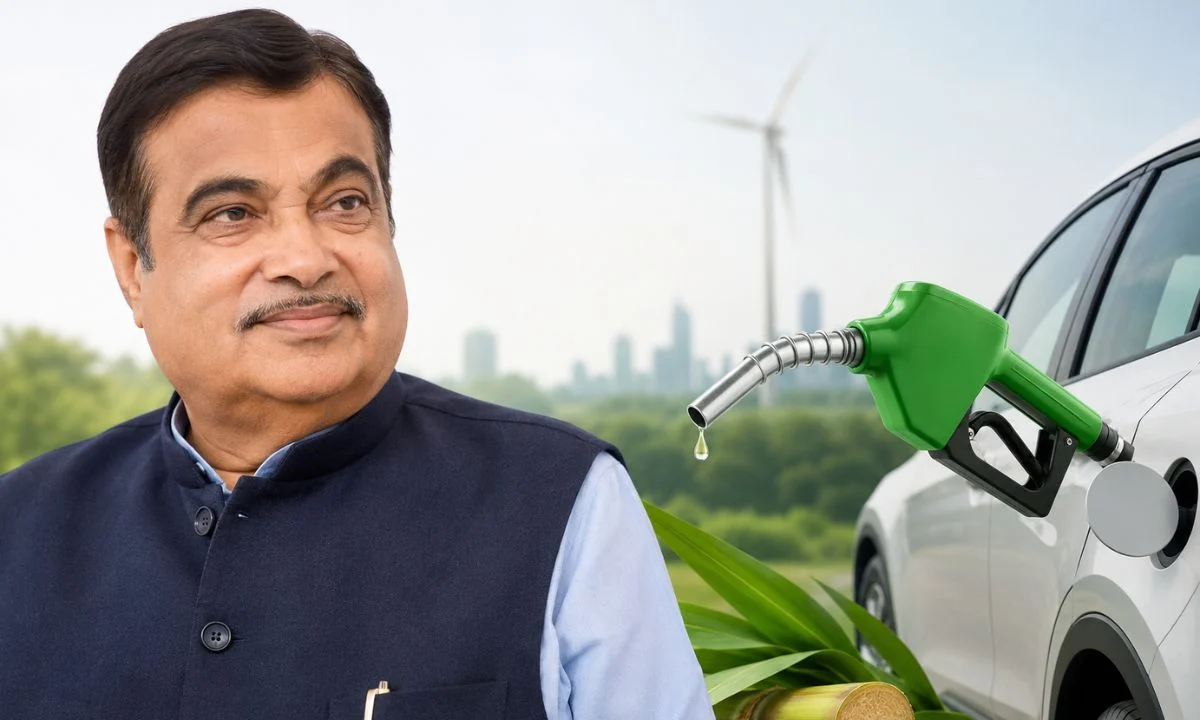
India’s Road Transport Minister Nitin Gadkari signed the E100 fuel regulations on June 12, 2026, giving 100 percent ethanol official legal status as a vehicular fuel for the first time.
The signing happened at the Sugar, Ethanol and Bio-Energy India Conference in Nagpur. Gadkari announced it alongside Petroleum Minister Hardeep Singh Puri at the launch of the E100-compatible Maruti Suzuki WagonR.
Key Takeaways
- Nitin Gadkari signed E100 fuel regulations on June 12, 2026, creating India’s first legal framework for vehicles running on pure ethanol.
- E100 cannot be used in any existing petrol or E20 vehicle. Only specially engineered flex-fuel vehicles qualify, and most of India does not own one.
- A 27 to 30 percent drop in mileage on E100 means the per-litre price advantage shrinks significantly in practice. A driver covering 1,200 km monthly saves about Rs 1,920 on E100 versus petrol, not the Rs 2,640 the per-litre price alone suggests.
- Over 90,000 fuel stations across India are not equipped for E100 dispensing. Retrofitting them could cost more than Rs 2,000 crore.
- Producing one litre of ethanol requires roughly 3,000 litres of water, a figure that sits uncomfortably against India’s worsening groundwater stress.
What Nitin Gadkari’s E100 Fuel India Regulations Actually Authorize
Gadkari’s regulations do one specific thing. They create a legal pathway for automakers, fuel retailers, and vehicle testing agencies to develop and deploy vehicles designed to run on pure ethanol. Without this framework, manufacturers could not get homologation for E100-compatible engines. Fuel distributors had no regulatory basis to sell E100 at the pump. The signing removes both blockers simultaneously.
The framework builds on a program that has already moved faster than most expected. India achieved 19.92 percent ethanol blending in June 2025, hitting the E20 target effectively on schedule. Blending climbed from 12.06 percent in ESY 2022-23 to 14.60 percent in 2023-24, then rose further to 17.98 percent by February 2025. That trajectory gave the government confidence to move the goalposts from blending to standalone fuel.
Gadkari also pointed to the economic logic. The E20 program has already saved more than Rs 1 lakh crore in crude oil import costs and generated approximately Rs 80,000 crore in additional income for farmers. India currently imports more than 85 percent of its crude requirement, contributing heavily to an annual fossil fuel import bill Gadkari has cited at Rs 22 lakh crore. Ethanol produced domestically from sugarcane and maize addresses both the trade deficit and the agricultural income problem at once.
Three Important That You Should Know
The regulatory approval is real. The vehicles are coming. But three structural problems stand between the announcement and mass adoption. Covering only the announcement without covering these is how a news article becomes a press release.
The mileage math.
Ethanol contains less energy per litre than petrol. On E100, vehicles see a 27 to 30 percent drop in mileage compared to petrol. If E100 is priced at Rs 65 per litre against petrol at Rs 120, the per-litre saving of Rs 55 shrinks once the mileage loss is factored in. A driver covering 1,200 km monthly would pay approximately Rs 2,880 on E100 after a 30 percent mileage penalty versus Rs 4,800 on petrol. That is a saving of Rs 1,920 per month, not the Rs 2,640 the per-litre price alone suggests. Owners who expect to halve their fuel bills may find the arithmetic more complicated at the pump. Individual savings depend on driving patterns, vehicle efficiency, and local fuel pricing.
The infrastructure bill.
Over 90,000 fuel stations in India are not designed to handle higher ethanol blends. Retrofitting a single outlet to dispense E100 costs Rs 2 to 3 lakh. Ethanol absorbs moisture and corrodes conventional storage and pipework. Nationwide, the retail-level investment could exceed Rs 2,000 crore before accounting for upgrades to bulk storage, transportation tankers, and pipeline systems. The regulation authorizes the fuel. It does not fund the infrastructure.
The water equation.
Producing one litre of ethanol from sugarcane or maize consumes approximately 3,000 litres of water, according to NITI Aayog data. Scaling ethanol production to replace a meaningful share of India’s petrol consumption would require a water draw that sits uneasily against the groundwater depletion already occurring in the states most active in sugarcane cultivation. Gadkari acknowledged this at the Nagpur conference, urging the industry to develop more water-efficient cultivation. The acknowledgment confirms the problem is understood. It does not resolve it.
Which Vehicles Are Actually Ready?
Maruti Suzuki launched an E100-compatible WagonR variant on Environment Day, June 5, 2026. Hero MotoCorp has introduced two flex-fuel motorcycles capable of running on pure ethanol. Toyota, Hyundai, MG, and Suzuki have announced plans for E100-compatible models in the coming weeks.
Having tracked this sector through multiple years of prototype announcements and delayed rollouts, the speed of OEM response this time is different. The WagonR launch with a sitting petroleum minister on stage signals that manufacturer commitment is not speculative. The regulatory clarity Gadkari has now provided is what was holding back investment decisions.
What these vehicles share is a set of engineering requirements that existing cars do not meet. Flex-fuel engines require corrosion-resistant fuel system components because ethanol degrades rubber seals and attacks metals in conventional fuel lines. They require recalibrated engine management systems to handle ethanol’s different combustion characteristics. And they require cold-start systems capable of igniting pure ethanol in low temperatures. Ethanol does not evaporate as readily as petrol, making winter starts in northern India genuinely difficult with E100 alone.
The government has been explicit. E100 is not for existing petrol vehicles. Regular cars running on petrol or E20 continue as before. This is the fact generating the most public confusion. The headline “E100 approved” reads to most car owners as something that affects them directly. It does not, unless they buy a new flex-fuel vehicle.
What The E85 Framework Signals
The E100 approval did not arrive alone. Draft rules for E85 fuel, an 85 percent ethanol blend, were expected to be notified around the same time. E85 addresses one of E100’s core technical problems.
The 15 percent petrol content in E85 significantly eases cold-start issues, making it a more practical option across India’s climate range. The fact that Gadkari’s ministry is advancing E85 and E100 in parallel suggests the end state is a flex-fuel vehicle that can switch between any blend from E20 to E100 depending on availability and conditions.
That architecture sidesteps the cold-start and distribution problems of pure ethanol without locking vehicles into a narrower fuel option.
What To Watch
Indian Oil Corporation launched E100 at 183 retail outlets across five states in 2024 as a pilot. The question now is the pace at which that network expands. Automakers will not produce flex-fuel vehicles at scale if fuel availability is patchy.
Fuel distributors will not invest in infrastructure if vehicle volumes are low. This is the same classic adoption problem that has constrained CNG and EV adoption in different ways. E100 will not escape it by regulation alone.
The government’s stated goal is to reduce India’s petroleum import dependence. At current blending rates, the program is already contributing. Whether E100 vehicles become a mainstream choice or a niche segment alongside electric and hydrogen options will depend on how quickly both sides of the fuel-vehicle equation fill in. The regulatory foundation is now in place. The build-out has to follow.